
As a professional videographer using Sony mirrorless cameras like the FX3 and A9iii, I’m frequently searching for the best perfoming ND filters. When you're shooting in log profiles or want to capture your subjects with a wide-open aperture, a solid ND or VND (Variable ND) is essential.
Over time, I’ve picked up a fair few NDs and VNDs across a range of brands and price points. I decided to put them head-to-head, and I’d love to show you my findings to help make your next filter purchase a little more straightforward.
The Testing Ground
Before we dive into the results, let's look at how we’re measuring performance. I tested the filters across three key areas: vignetting (or cross-patterning), impact on sharpness, and colour shift.
For me, colour shift is actually the least of our worries. We can usually fix a temperature shift in-camera with a custom white balance or tweak it later in post-production. Softening of the image or heavy vignetting, however? That’s a headache that is either impossible to remedy or incredibly time-consuming.
To keep things completely fair, I tested a mix of 67mm and 82mm filters on their native mounts. Buying an 82mm filter and using a step-up ring on a 67mm lens is a great, relatable workaround to get better edge sharpness and reduce cross-patterning, but for this test, it was important to see how they perform on their intended thread size.
The test images give you a sense of how much vignetting and colour shift each filter produces. I’ve shot everything against a pure white backdrop as our control, so you can easily spot the differences.
There are a few filters I haven't got my hands on just yet but would love to test in the future: the Breakthrough Photography X4 (3 and 6 stops), the Nisi JetMag Pro, the new Urth Variable ND2-32 Pro, and the offerings from Freewell. If I ever get to try those out, I’ll be sure to update this post.
Now let's explore how the current lineup stacks up, ranked from worst to best:
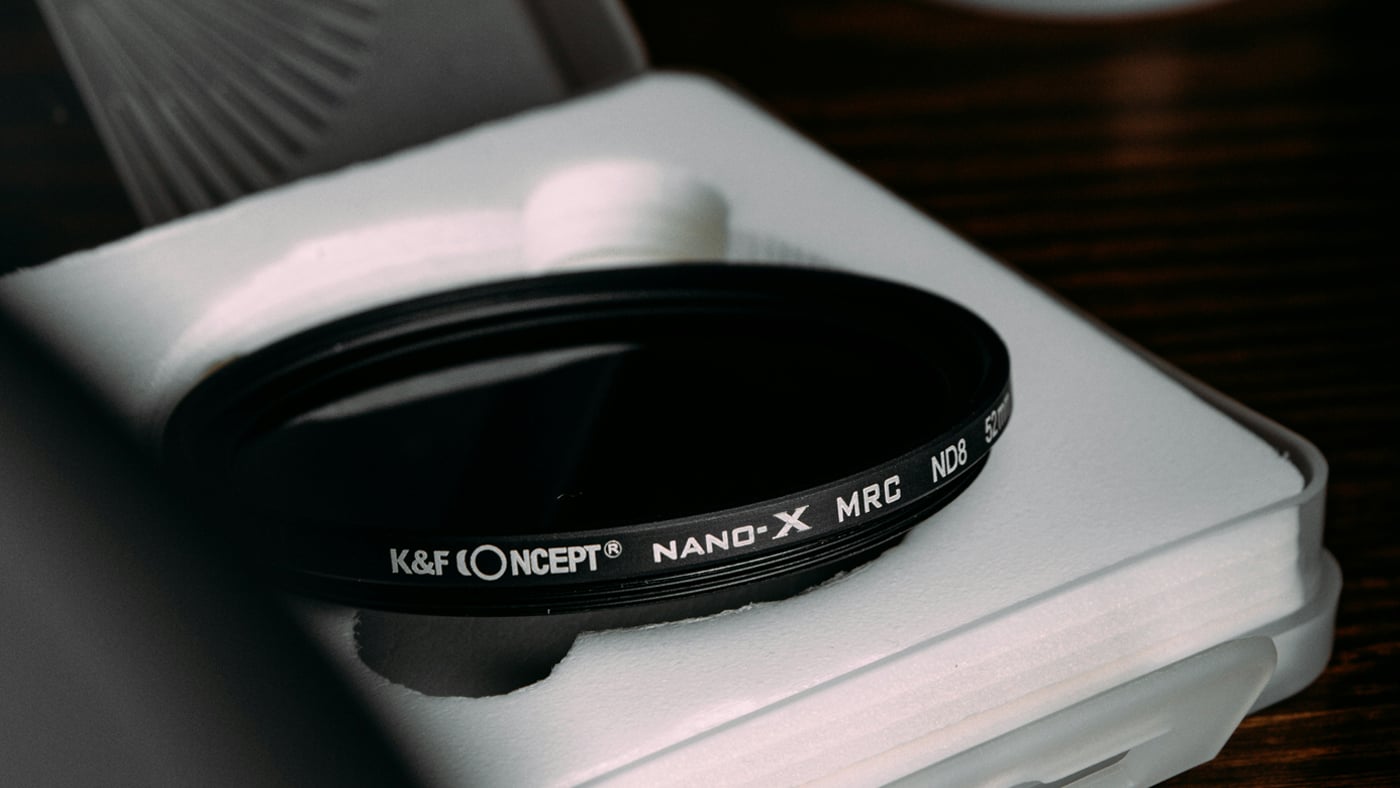
6. K&F Concept Nano-X Variable ND2-400

This one sits at the bottom of the pile due to a pretty significant drop in image quality at higher densities.
- Colour Shift: At ND2 there is a noticeable +3.6 temperature shift with zero tint shift, but cranking it to ND400 introduced a rather heavy +4.1 temperature shift alongside a -2.7 tint shift.
- Sharpness: It struggled with corner sharpness and became increasingly soft in the centre as the density was cranked up.
- Vignetting: It showed heavier vignetting than its competitors at low densities and developed quite a lot of cross-patterning at ND400.
5. Neewer Nano HD Variable ND ND2-ND32

While slightly better than the K&F in a few areas, it still suffered from noticeable softening.
- Colour Shift: There is a +2.8 temperature shift and a -1.9 tint shift at the ND2 mark, which settles slightly to a +2.2 temperature and -1.5 tint shift when dialled up to ND32.
- Sharpness: It tied with the K&F for the softest corners and was the softest filter tested in the centre at its ND32 setting.
- Vignetting: Performed on par with the 7Artisans at low densities, but the sharpness issues hold it back.
4. Urth ND64-1000 Variable ND (Plus+).

The Urth offers a reliable middle-ground performance with shifts you can easily plan for.
- Colour Shift: Very consistent shifts (+2 temperature, -1.3 tint) across both the ND64 and ND1000 ends.
- Sharpness: Centre sharpness had only very slight softening at ND64. It becomes a bit more noticeable at ND1000 but remains perfectly acceptable.
- Vignetting: Handled better than the 7Artisans, K&F and Neewer in this regard, though it did show more cross-patterning than the Haida at higher densities.
3. 7artisans True Color VND (2-5 stops).

What if your budget filter could punch above its weight? The 7artisans performed remarkably well for sharpness, though it struggled with optical artefacts at the higher settings.
- Colour Shift: Exceptional at low density with absolutely zero shift at 2 stops, though when pushed to 5 stops it introduced a +1.1 temperature shift and a -0.7 tint shift.
- Sharpness: Centre sharpness was practically identical to the control shot. It ranked joint second-best for corner sharpness, trailing just behind the NiSi.
- Vignetting: Its main weakness. A significant cross pattern began to appear at the 5-stop mark.
2. Haida PRO II 2-in-1 CPL + VND.

Now we're getting into the top tier. The Haida is a brilliant performer, particularly when it comes to image clarity and keeping artefacts in check.
- Colour Shift: A slight cooling effect at 3 stops with a -0.9 temperature and +0.6 tint shift, which nudged to a -1.5 temperature and +1.6 tint shift at 7 stops.
- Sharpness: Showed minimal, if any, difference in centre sharpness compared to the control. More importantly, the corners remained acceptable even when pushed to 7 stops.
- Vignetting: Exhibited the least amount of cross-patterning of all the variable NDs tested.
1. NiSi Circular ND1000 (3.0) 10 Stop PRO Nano.

The NiSi took the top spot, though it's worth noting it has a distinct advantage: it’s a fixed ND rather than a variable one.
- Colour Shift: There is absolutely zero temperature shift to worry about, but it did show a +1.6 tint shift which can easily be tweaked in-camera or in post.
- Sharpness: Centre sharpness was identical to the control, and it was the undisputed champion for corner sharpness.
- Vignetting: Beautifully handled, with only minimal darkening in the very corners.
The Verdict
If you're after a highly capable VND that respects your budget, the 7Artisans is a fantastic starting point. If the Urth performed better with sharpness at the higher densities, then it would be a strong contender (perhaps the new Pro range of their VND filters would shine in this regard). However, the Haida Pro II isn’t drastically more expensive than the 7Artisans filter and manages cross-patterning beautifully, making it my top recommendation if you’re looking for a reliable, high-value VND for video work.
While the fixed NiSi ND1000 performed the best optically, a 10-stop filter is quite strong for everyday use. It really only shines when shooting wide open on a camera with a high base ISO like the Sony A9iii at ISO 2000. It might not be the go-to choice for everybody's kit bag, but it certainly gives a lot of confidence in NiSi’s broader range of fixed ND filters.
I hope this helps you narrow down your choices and get back to doing what you do best: capturing incredible footage.
Just to keep things completely transparent, some of the links in this article are affiliate links. If you use them to add a new filter to your kit, I may earn a small commission. The best part? It won’t cost you a single penny extra. In fact, sometimes these links even unlock a cheeky discount just for you. Using them is a brilliantly simple way to support the blog, helping me test more gear and share my findings.
Back to Blog